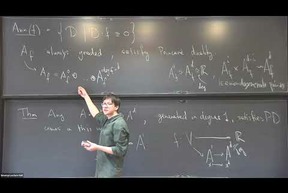
A classical construction associates a Poincare duality algebra
to a homogeneous polynomial on a vector space. This construction
was used to give a presentation for cohomology rings of complete
smooth toric varieties by Khovanskii and Pukhlikov and...
For every surface S, the pure mapping class group G_S acts on
the (SL_2)-character variety Ch_S of a fundamental group P of S.
The character variety Ch_S is a scheme over the ring of integers.
Classically this action on the real points Ch_S(R) of...
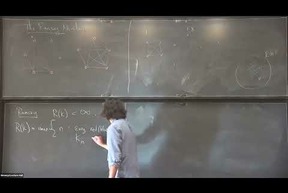
In this talk I will try to motivate the interest and some of the
mystery in the Ramsey numbers R(k), which are fundamental
quantities in combinatorics. I will go on to discuss some recent
progress on our understanding of these numbers and make some...
The classical Serrin’s overdetermined theorem states that a C^2
bounded domain, which admits a function with constant Laplacian
that satisfies both constant Dirichlet and Neumann boundary
conditions, must necessarily be a ball. While extensions of...
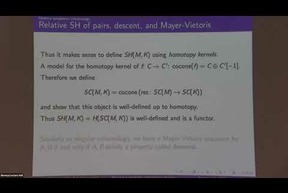
Relative symplectic cohomology, an invariant of subsets in a
symplectic manifold, was recently introduced by Varolgunes. In this
talk, I will present a generalization of this invariant to pairs of
subsets, which shares similar properties with the...
The well-known Zig-Zag product and related graph operators, like
derandomized squaring, are fundamentally combinatorial in nature.
Classical bounds on their behavior often rely on a mix of
combinatorics and linear algebra. However, these traditional...
Eisenstein proved, in 1852, that if a function f(z) is
algebraic, then its Taylor expansion at a point has coefficients
lying in some finitely-generated Z-algebra. I will explain ongoing
joint work with Josh Lam which studies the extent to which
the...
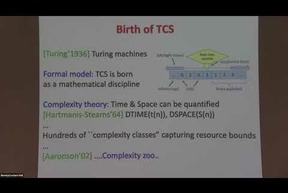
I will discuss some well-known and less-known papers of Turing,
exemplify the scope of deep, prescient ideas he put forth, and
mention follow-up work on these by the Theoretical CS
community.
The well-known Zig-Zag product and related graph operators, like
derandomized squaring, are fundamentally combinatorial in nature.
Classical bounds on their behavior often rely on a mix of
combinatorics and linear algebra. However, these traditional...
Given a path-connected topological space X, a differential
graded (DG) local system (or derived local system) is a module over
the DGA of chains on the based loop space of X. I will explain how
to define in the symplectically aspherical case...